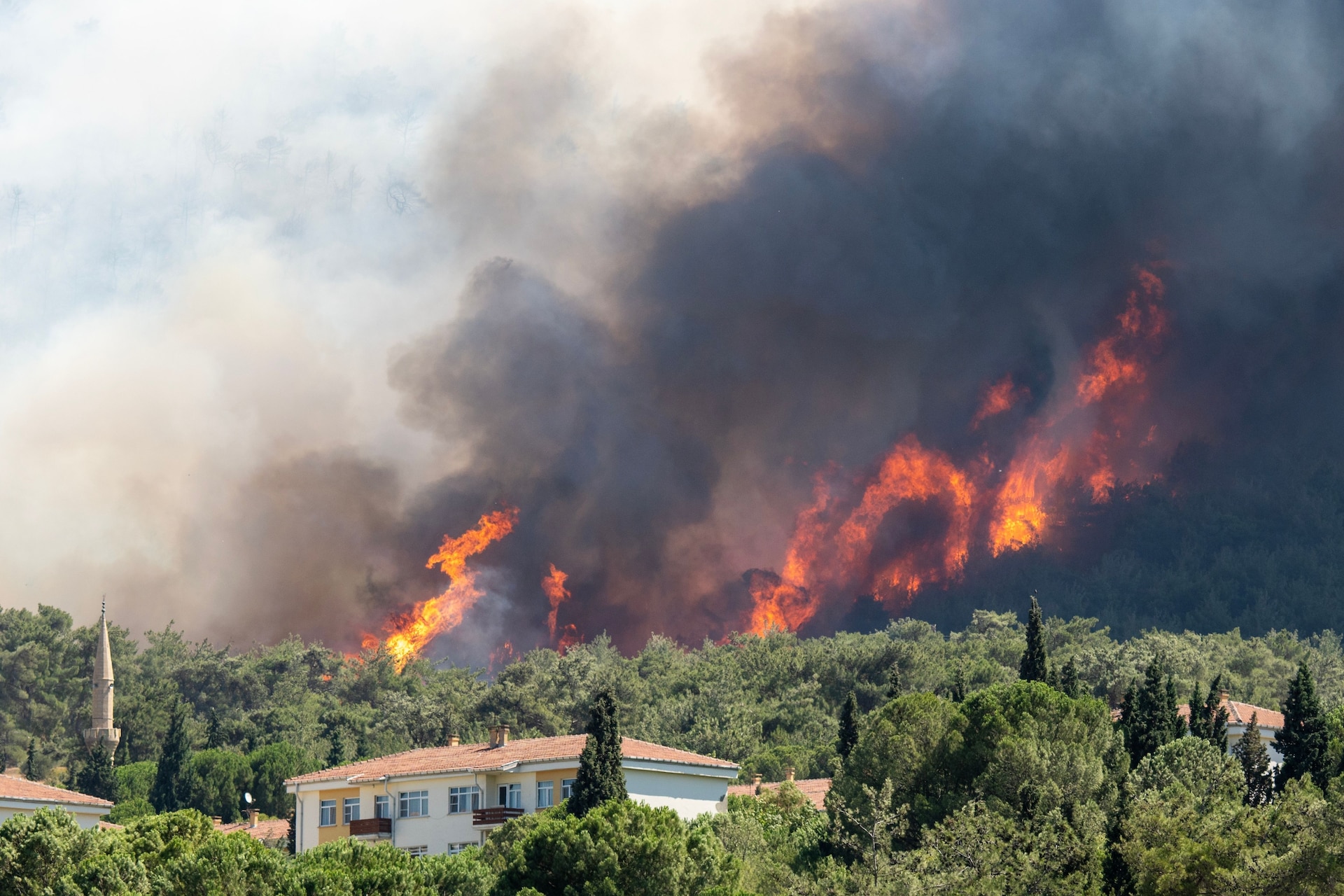
Living in beautiful natural environments, close to forests, open ranges, and lakes can bring a sense of peace and calm but also bring a risk of wildfire. These areas, known as wildland-urban interface (WUI), are where human development meets nature.
As our population grows, the construction of neighborhoods and housing is encroaching on undeveloped wildland areas. The U.S. Department of Agriculture Forest Service, Northern Research Station, reports that as of 2020, 9.4 percent of the land area and almost a third of all houses in the continental United States (32 percent) were in WUI areas.
Wildfires are no longer just something that happens in the thick trees of uninhabited forests. As our neighborhoods continue to get closer to wildland areas, we are seeing more fires spreading into neighboring communities, leaving destruction behind.
One of the leading causes of fire spreading is from the wind. As winds fan the flames, burning embers can travel long distances through the air, landing on the roofs of homes miles away. If the roofing system is not fire resistant, the roof can erupt into flames and cause the entire home to burn. While we can’t control the risk and spread of wildfires, we can help protect our homes by making sure we have Class A fire-resistant roofing systems that can stand up to those airborne burning embers.
Demystifying WUI: What It Means for Your Property
The U.S. Fire Administration (USFA) defines WUI as “the zone of transition between unoccupied land and human development.” Many think that wildfires are something that only happens in the western U.S. or the mountains, but USFA shared that more than 60,000 communities across the U.S. are located in WUI zones.
The WUI area continues to grow by 2 million acres a year and the top 5 states with the greatest number of homes in WUI areas are:
5 -Pennsylvania; 4 - North Carolina; 3 – Florida; 2 – Texas; 1 – California
However, while WUI growth is nationwide, the adoption and active enforcement of strict WUI building codes remain concentrated primarily in Western states (such as California and Colorado), where wildfire severity poses the greatest risk. In these jurisdictions, updated mandates are designed to mitigate risk to life and property. While specific requirements vary by region, WUI codes generally mandate:
Building materials – Class A roof assemblies and other exterior components of homes such as siding, gutters, windows must be noncombustible
Building density and location – guidance on how close together homes or structures can be and required setbacks
Vegetation management – landscaping requirements, vegetation management and brush clearing
Emergency vehicle access – length and width of driveways, turnaround points, access road requirements to ensure they are easily accessible by emergency responders
Fire suppression systems – automatic sprinkler systems, spark arrester requirements and storage guidelines for propane tanks
Colorado is one of the most recent jurisdictions to update their WUI codes with strict requirements related to roofing materials, stating, “Roofs shall have a roof covering or roof assembly classified as Class A when tested in accordance with ASTM E108 or UL 790.”
Many insurance companies have strict underwriting standards for insuring properties located in WUI zones. They won’t insure the property unless they know that it adheres to the codes designed to reduce wildfire risk including fire-resistant roofs, ember-resistant vents and adequate defensible space zones. Depending on the insurer, homeowners may be eligible for a premium discount by meeting all the WUI zone requirements.
Anatomy of a Fire-Resistant Roof: Class A & WUI Compliance
A Class A fire rating is the highest fire-resistant rating that a roof can achieve when evaluated under ASTM E108 or UL790 standards. To earn this rating, the roof must be able to prevent embers from igniting the material, withstand direct fire exposure, limit the spread of flames and prevent the fire from penetrating the roof deck below.
Under WUI code requirements, typical shingle system requirements center around Class A roof assemblies (shingles, underlayment, and decking meeting UL 790 Class A or ASTM E108 standards). Additional required components include eave and valley protection (typically using a mineral-surfaced cap sheet or other fire-rated membrane along with valley metal) and vents built with ember-resistant screening to help block wind-blown embers.
Ensuring Every Home Has the Class A Protection Needed to Stand up to Wildfire Risk
If you are a contractor working with homeowners in WUI zones, it’s important to guide them through the local codes and help them understand what it means to be in a WUI zone. Explain what a Class A rating means and provide the documentation to show that the roofing system will stand up to wildfire risks.
If you are a homeowner living in a WUI zone, contact a GAF-certified contractor* to evaluate your current roof and learn about Class A options to bring your roof into compliance and help provide the protection your home and family needs from wildfire risk.
No matter your style preference, GAF has a Class A roofing solution to meet your home’s needs with the following shingles having achieved the Class A fire-resistant designation:
Camelot® II
Grand Canyon®
Grand Sequoia®
Grand Sequoia® AS
Grand Sequoia® RS
Royal Sovereign®
Slateline®
Timberline AS® II
Timberline HDZ®
Timberline HDZ® RS
Timberline HDZ® RS+
Timberline Ultra HD® or Timberline® UHD
Timberline UHDZ®
Timberline® AH
Timberline® CS
Timberline® NS
Timberline Solar HDZ™
Woodland®
Seal-A-Ridge® Ridge Cap Shingles
TimberTex® Premium Ridge Cap Shingles
TimberCrest® Premium Ridge Cap Shingles
Z® Ridge Distinctive Ridge Cap Shingles
Pro-Start® Starter Strip Shingles
WeatherBlocker Premium Starter Strip Shingles
Explore GAF’s complete portfolio of Class A and WUI-compliant products and roofing systems.
*Contractors enrolled in GAF certification programs are not employees or agents of GAF, and GAF does not control or otherwise supervise these independent businesses. Contractors may receive benefits, such as loyalty rewards points and discounts on marketing tools from GAF for participating in the program and offering GAF enhanced warranties, which require the use of a minimum amount of GAF products. Your dealings with a Contractor, and any services they provide to you, are subject to the GAF Contractor Terms of Use.
