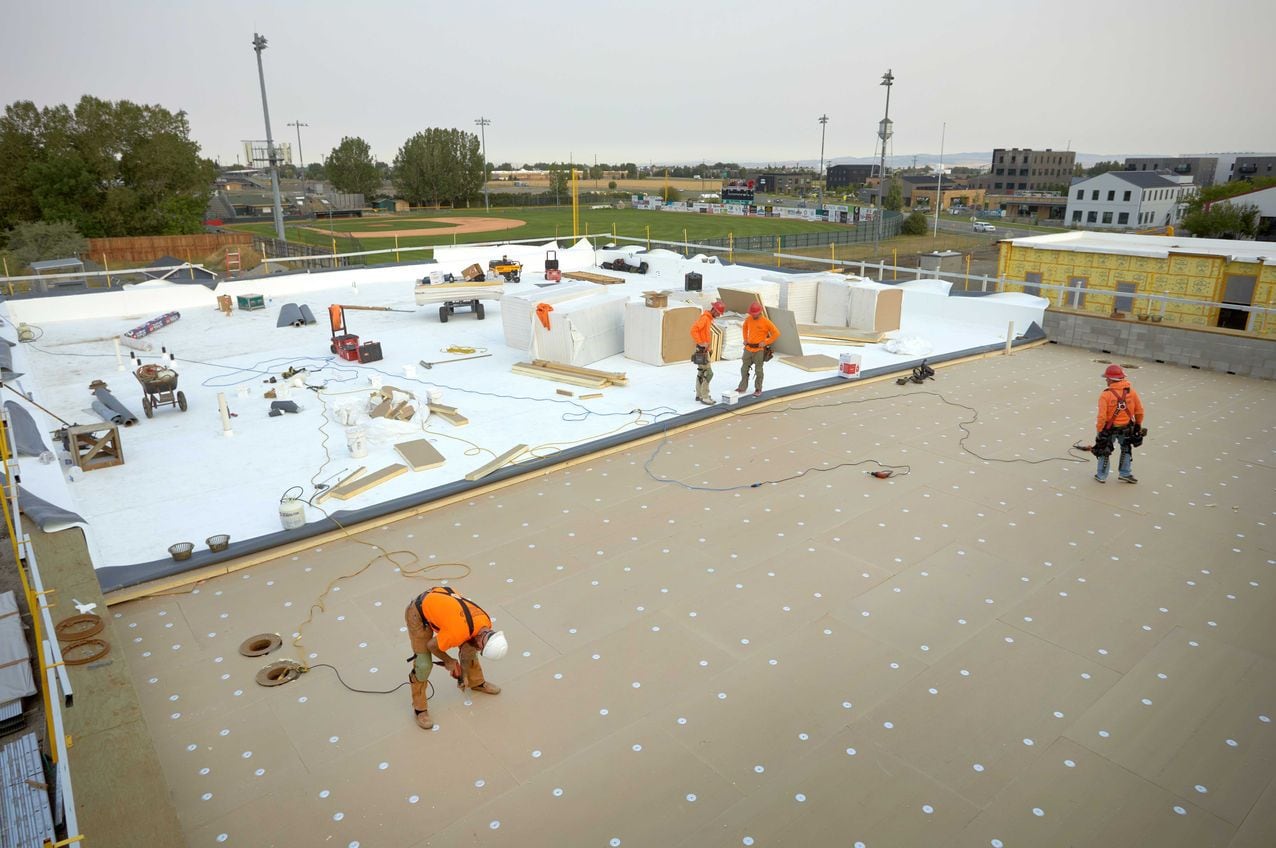
Un sistema de techo multimembrana (BUR) es una opción popular para edificios con techos de pendiente baja o techos planos. A menudo llamado BUR por sus siglas en inglés, este sistema se utiliza desde hace más de 100 años en Estados Unidos.
Los sistemas BUR son conocidos por ofrecer excelente protección debido a su naturaleza redundante, están compuestos de varias capas de láminas y asfalto. Las capas ofrecen a la construcción resistencia climática y protección de alto rendimiento. Estas capas suelen estar recubiertas por una cubierta superior o una capa final de asfalto y grava
Componentes del sistema de techo multimembrana
Los sistemas BUR pueden construirse de diversas maneras. A menudo comienzan con una hoja base instalada sobre el aislante de polisocianurato (polyiso) o el tablero para cubierta, normalmente mediante sujetadores mecánicos. Esta hoja base actúa como la capa inferior de protección del sistema de techo y proporciona una superficie que permite que las hojas posteriores se adhieran con asfalto caliente.
Se aplica una capa de asfalto sobre la hoja base para instalar el fieltro de refuerzo, a veces llamado cubierta de capa. Aunque los contratistas tradicionalmente aplican asfalto caliente con mopa sobre la hoja base para instalar la cubierta de capa, los avances en la fabricación han generado opciones alternativas. Por ejemplo, los contratistas también pueden usar métodos aplicados con soplete, en frío o autoadherentes.
Cuando se satura en asfalto o adhesivo aplicado en frío, el fieltro de refuerzo crea una barrera que proporciona resistencia adicional a la intrusión de agua. El proceso se repite aplicando asfalto e instalando capas adicionales hasta alcanzar la cantidad deseada de cubiertas de capa. Luego, el sistema se remata con una cubierta superior con superficie mineral o se cubre con una capa de inundación de asfalto, seguida de la aplicación inmediata de grava o escoria, la cual actúa como una capa adicional de protección contra el tránsito peatonal o los rayos UV.
Este video ofrece una explicación sencilla de las capas de un sistema multicapa típico.
Beneficios del techo multimembrana
El techo multimembrana ofrece muchos beneficios.
Tecnología de eficacia comprobada
Es difícil cuestionar más de 100 años de historia.
Redundancia
Los techos multimembrana ofrecen varias capas de protección. Por lo tanto, si la capa superior se daña, las capas adicionales debajo continúan protegiendo el edificio contra la intrusión de agua.
Garantías
Los sistemas de techo mutimembrana pueden ser elegibles para garantías de hasta 20 años, en función de los materiales que se utilicen y del sistema instalado. Consulta con el fabricante los requisitos y la cobertura de la garantía.
Disponibilidad de capas superiores reflectantes
Se ofrecen capas superiores con recubrimiento blanco, diseñadas para reflejar la radiación solar y contribuir a reducir la temperatura interior. Estas membranas también están incluidas en el sitio web del Cool Roof Rating Council, lo que puede ayudar a identificar las propiedades de reflectancia solar del acabado de tu techo.
Cuándo usar un techo multimembrana
El techo multimembrana funciona mejor en techos de pendiente baja, ya que las características del material protegen contra el agua estancada y los impactos fuertes. Además, una membrana BUR es ideal cuando se prevé un alto tránsito peatonal en el techo por parte de técnicos u otros empleados. Su construcción multicapa le permite soportar el tránsito peatonal sin afectar la integridad del sistema diseñado.
También se ha demostrado que este sistema es eficaz en zonas con condiciones climáticas severas. Las membranas BUR están diseñadas para resistir variaciones extremas de temperatura. Para brindar protección en zonas soleadas, los contratistas deben instalar una cubierta superior que contenga un acabado mineral. Las opciones mejoradas de reflectancia solar, como se mencionó anteriormente, ofrecen una superficie blanca que refleja los rayos ultravioleta (UV), lo que aumenta la eficiencia energética de los edificios comerciales.
El techo multimembrana también puede utilizarse como hoja base con capas de membranas de polipropileno atáctico (APP) o estireno-butadieno-estireno (SBS). Este sistema de capas diversas puede proporcionar beneficios adicionales del betún modificado, como una resistencia superior a los rayos UV y mayor flexibilidad cuando sea necesario.
Costos de instalación del techo multimembrana
Los sistemas BUR pueden tener costos iniciales más altos que otras soluciones comerciales. Requieren múltiples capas (incluida una hoja base, varias cubiertas de capa y una cubierta superior), lo que incrementa los costos. Los métodos de instalación también pueden requerir mucha mano de obra y llevar tiempo (cuatro días o más), según el método de instalación y el tamaño del techo.
Sin embargo, los sistemas BUR pueden ser rentables a largo plazo, ya que requieren poco mantenimiento. Con garantías de hasta 20 años, los edificios obtienen un techo duradero con protección excepcional y menor riesgo de filtraciones, lo que reduce la necesidad de reparaciones costosas. Además, combinar un sistema base de cubiertas de capa BUR con una membrana superior de APP o SBS brinda al techo los beneficios de un sistema de betún modificado mientras mantiene bajos los costos.
Cómo elegir el material adecuado para tu próximo proyecto
Tienes muchas opciones para un sistema de techo asfáltico, cada una con distintos beneficios. Puedes obtener más información sobre cada sistema y sus métodos de instalación en la lista de reproducción de Aspectos básicos sobre techos asfálticos comerciales 101 del canal de YouTube de GAF. También puedes comparar las características y garantías disponibles de los productos de techos comerciales de GAF.
¿Te interesa analizar las opciones con otro profesional de techos? Comunícate con un gerente de Territorio Comercial en tu zona y aprovecha los recursos para profesionales del diseño y arquitectos de GAF.
