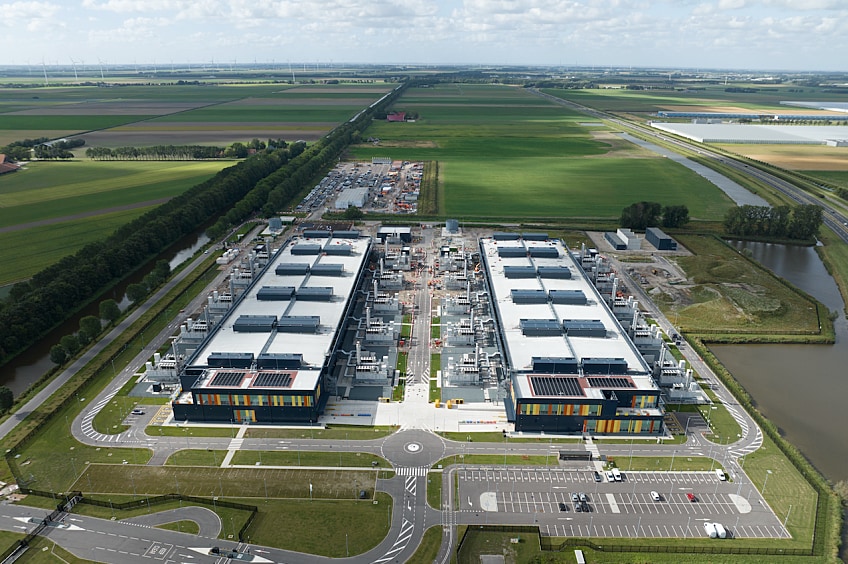
En la era de la información, los centros de datos son indispensables para mantener en funcionamiento los engranajes de la sociedad. Los centros de datos son edificios especializados que albergan la tecnología remota necesaria para las diversas operaciones digitales de las organizaciones, como servidores, dispositivos de almacenamiento, equipos de red, generadores y sofisticados sistemas de refrigeración y supervisión. Esta tecnología es fundamental para ejecutar aplicaciones, alojar sitios web, gestionar datos de clientes y, en general, garantizar el acceso continuo a la información.
Al igual que con cualquier edificio comercial, un sistema de techo fiable es esencial para la integridad estructural, la eficiencia energética y la continuidad de las operaciones comerciales. A continuación, ofrecemos una visión general de los conjuntos de techos híbridos y de cómo estos sistemas híbridos pueden proporcionar una solución de techo superior para los centros de datos.
Necesidades específicas de los centros de datos
Los centros de datos se clasifican en niveles que van del I al IV, un sistema de clasificación que indica la fiabilidad de la infraestructura del centro de datos. Las instalaciones más básicas de nivel I no garantizan la redundancia de ningún sistema y pueden permanecer "desconectadas" hasta 26 horas al año. Sin embargo, un centro de datos de nivel IV es totalmente redundante y "tolerante a fallas", lo que significa que solo se le permite estar desconectado durante un total de 26 minutos al año.
Por lo tanto, la construcción del techo de un centro de datos es fundamental no solo para proteger el interior del edificio, sino también para mantener el intervalo de temperatura ambiente necesario para los equipos sensibles que se encuentran en su interior. Si consideras todas las posibles razones por las que un centro de datos podría tener que desconectarse, seguramente no querrás que los problemas con el techo sean una de ellas. Cuando se trata de cumplir con estos exigentes requisitos, los sistemas híbridos pueden responder a todas las necesidades.
Comprender los sistemas híbridos: ¿qué es un conjunto de techo híbrido?
Un techo híbrido está compuesto por dos sistemas de membranas para techos, cada uno con diferentes materiales y tecnologías, combinados en un solo conjunto de techo. Cada sistema ofrece ventajas específicas y, cuando están juntos, el sistema híbrido combina las mejores características de ambos.
Un ejemplo de conjunto de techo híbrido es una base de betún modificado con una capa superior compuesta por una membrana de una sola capa. Para comprender mejor por qué dos sistemas de techo pueden ser mejores que uno solo, examinemos las ventajas de cada sistema.
Sistemas de betún modificado
El sistema tradicional para techos de baja pendiente es el techo asfáltico multimembrana (BUR). Cuando se concibió por primera vez en la década de 1890, un BUR típico se componía de múltiples capas redundantes de trapos, papel o amianto recubiertos con asfalto caliente. Con el tiempo, las capas evolucionaron hasta convertirse en membranas de betún "modificado" compuestas por fieltros, tejidos o láminas de fibra de vidrio impregnados de asfalto, a los que se les agregaba flexibilidad mediante modificadores de caucho o plástico. La capa final de un BUR suele ser un revestimiento de asfalto con grava incrustada o una cubierta superior granulada con superficie mineral.
Según la composición química de las capas base y superior, las capas actuales pueden instalarse mediante mopa caliente, soplete, aplicación en frío o autoadhesión. Las múltiples capas redundantes de la tecnología de betún modificado contribuyen a su durabilidad y a su gran resistencia a las perforaciones. Las membranas bituminosas para techado de GAF, como RUBEROID®, GAFGLAS® y Tri-Ply®, cuentan con un largo historial de rendimiento probado y durabilidad demostrada.
Membranas para techado: techo termoplástico
Las membranas de una sola capa son el sistema de techo preferido para la mayoría de los techos comerciales debido a su facilidad de instalación y su costo relativamente bajo. La mayoría de las membranas de una sola capa son de poliolefina termoplástica (TPO) o cloruro de polivinilo (PVC).
Ambas ofrecen un rendimiento excelente, con juntas resistentes soldadas al calor, resistencia a la intemperie a largo plazo y resistencia a los rayos UV. Las membranas de TPO GAF EverGuard® tienen la ventaja añadida de ser resistentes a los hongos naturales y de ofrecer un alto grado de flexibilidad, mientras que las membranas de PVC GAF EverGuard® ofrecen una mayor protección contra el fuego y los productos químicos.
Estas membranas de una sola capa se pueden instalar más rápidamente que un sistema tradicional de betún modificado utilizando un sistema de acoplamiento mecánico, soldadura por inducción o adhesivos. También son resistentes al agua estancada y fáciles de reparar y mantener. El mayor índice de reflexión solar de las membranas de una sola capa también contribuye a la eficiencia energética del techo, lo que puede ayudar a reducir los costos de refrigeración del edificio.
Beneficios de los sistemas híbridos
Cuando se combina la resistencia, la redundancia y la resistencia a las perforaciones, todas características comprobadas de los conjuntos de betún modificado, con la flexibilidad, la facilidad de instalación y la eficiencia energética de las membranas para techado de una sola capa (techo termoplástico), se obtiene un sistema de techo difícil de superar.
Las ventajas de combinar estas dos tecnologías de techo incluyen:
Mayor durabilidad y longevidad
Mayor eficiencia energética
Rentabilidad a lo largo del ciclo de vida del sistema
Flexibilidad en diseño y aplicación
Superar los desafíos únicos de los centros de datos
Gracias a su redundancia multicapa, su sólida protección contra fugas y su mayor eficiencia energética, los sistemas híbridos pueden satisfacer los exigentes requisitos de la construcción de techos para centros de datos.
Un sistema de techo híbrido de GAF también puede ser una excelente solución para reacondicionar o recuperar el techo de un centro de datos. Si el BUR existente está en relativamente buen estado y presenta un nivel mínimo de humedad subyacente, puedes instalar una membrana de TPO de una sola capa con revestimiento de vellón como nueva capa superior sin necesidad de retirar el sistema de techo existente, lo cual puede resultar molesto y costoso. Esta adición puede aumentar la vida útil de todo el conjunto del techo gracias a su protección a largo plazo contra la intemperie y su resistencia a los rayos UV. Además, puedes instalar la membrana de una sola capa con opciones con bajo contenido de compuestos orgánicos volátiles (COV), lo que minimiza tanto el olor como las molestias por ruido.
Ya sea para un edificio nuevo o una remodelación, los sistemas de techos híbridos GAF ofrecen múltiples ventajas a largo plazo para los centros de datos. Para obtener más información, explora la página de GAF sobre centros de datos.
